Thursday, April 7, 2016

What's Happening Around Lyon Academy? April 7th, 2016

Take a look at several highlights from around our school this week. If you see an anchor chart, student work, or something else in the building you would like showcased for the staff, please send it to Tyler.Archer@slps.org.

Ms. Wolfenden's anchor chart helps students to visually make the connection between money and its value. 

Ms. Salmo's students sing the "Vowel Song" to help them with understanding their vowels and identifying them. 

In Ms. Kempf's class, a difficult math problem is made simple with an anchor chart that teaches how to make groups of ten. 

Ms. Connell's "My Strategies to Solve" anchor chart reminds students of several ways to solve difficult math problems. 

Ms. Trapp helps students to create compound words by using this color-coded anchor chart. 


Ms. Latta helps students to attack Constructed Response questions with this"QUAN" anchor chart. 

Ms. Cychowski's students engaged in a roller coaster experiment and then displayed their results on a poster they created. 

Ms. Pocost used social media and Instagram as a hook to involve students in drawing and representing their ecosystem. 

Ms. Davison's vocabulary strategies anchor chart outlines examples and strategies students can use to determine the meaning of unknown words. 


Tuesday, March 15, 2016

Student Work as Formative Assessment

One of the most effective ways of assessing student progress is through student work and high quality feedback. Research shows that when students receive frequent feedback designed to help them improve, they are more successful. Similarly, students who are exposed to student work and feedback are more likely to learn from their own work and the work of others. This is why teachers are asked to post student work with descriptive feedback in the classroom and hallway. Posting student work also provides students with an opportunity to feel successful about the work they do and receive recognition from their peers.

To help you prepare high-quality tasks for your students and display in the hallways consult the following resources:

Student Work Analysis Protocol (and Student Work Reflections/Feedback Form)
SLPS Project Description Sheet

High-quality student work should demonstrate a deeper level understanding (DOK 3 & 4) and indicate a student's achievement towards a specific learning target or standard. When posting student work, work should include a project description sheet, rubric and descriptive feedback. Multi-step projects or processes should be displayed, rather than simple recall worksheets or exit tickets. The examples below are recent examples of student work postings from our hallways that reflect some of the work students are doing in ELA classrooms:


Would you like to win a donut for reading the blog? What about a cup of coffee? Be one of the first five teachers to e-mail a task (with rubric) that you plan to use in your classroom in an upcoming lesson to Mr. Archer for feedback and you'll receive a donut and coffee the week after Spring Break! You'll also receive feedback about the task you plan to do with your students. 

Friday, March 4, 2016

Checking for Understanding and Reteaching Strategies

Throughout our professional development this year we have spent a significant amount of time discussing formative assessment. Most recently, we have discussed checking for understanding procedures and ways to respond to with instruction. Remember, Checking for Understanding consists of two key actions:

While you teach, constantly assess what your students understand. Gather responses from not just one but several students who represent different levels of achievement and performance. Use the data to estimate how many in your class understand and what segments of the class you might have left behind. In this process, ask Cold Call questions with the conscious purpose of sampling understanding. Also Circulate as students do desk work, with the conscious purpose of sampling levels of mastery in written answers. Exit Ticket is yet another technique to use with Check for Understanding.

Respond to misunderstanding by reteaching, and usually reteaching differently.  There’s no point to checking unless you also respond (the more promptly the better) to improve understanding. The shorter the delay, the more likely the intervention will work. 

When thinking about implementing a check for understanding in the classroom, think about the following process:

Select a lesson plan for an upcoming lesson. Note in your plan where you will want to Check for Understanding. Consider:
1. What errors students are likely to make. What misunderstandings may they have?2. The method you will use to check. What question(s) will you ask and how? Script your questions in the lesson plan.
3. Plan (and possibly write down) target student responses. What will you specifically look for in students’ work?
4. How you can standardize students’ work pages so that you can quickly find their work on a particular question (or set of questions).  

For each instance of checking, note what may be your best choice of a way to reteach at the moment.
After class, assess your plan and actual performance in class to improve and broaden choices in your next plan and lesson. In your next plan, include any needed reteaching that you couldn’t do on the spot. Generally, teachers are better at checking for gaps in student mastery than they are at acting on those gaps. Be realistic about where you are, but do plan to improve at filling gaps well and early. 

The following are some strategies that can be utilized to check for understanding, their advantages, pitfalls and challenges, and ways to address those challenges: 


Strategies and Their Advantages
Pitfalls and Challenges
Possible Solutions
Questioning
    Immediate
    Done during lesson
Right answers from individual students may not equate with whole-class mastery.
Track students’ answers and look for trends.
Observation
    Immediate
    Independent work- no copying   or piggybacking
Observing students’ work at their seats is likely to entail some delay after the moment of actual teaching. To be effective, observing requires consciously targeting a specific skill question and a valid sample of the class.
Pick one question to target; track responses. Observe during Do Now. Target specific students.
Quick Oral Quiz
    Immediate
    Done during lesson
The teacher needs to be sure to tap the right sample of students.
Intentionally target students who are high, medium, and low on different skills. Track answers. Cold Call specific individuals.
Hand Signals
    Silent
    Quick
    Whole Class
Students may copy or piggyback.
Ask students go give signals with their eyes close. Ask for hand signals from smaller subset of class.
Slate
    Silent
    Quick
    Whole Class
Students may copy or piggyback.
Explain why piggybacking does not serve the student’s own best interest. Signal the moment when everyone should hold up his or her slate. Have students hold up slates at each step of a problem.
Reteaching
As teachers we may tend to delay reteaching, rather than do it right away after data show a lack of understanding.
Reteach as soon as possible, even if this requires adjusting objectives and lesson plans.

When reteaching, it is important to go beyond "just repeating" the material that was already covered.  Repeating what you did before in the same or slightly different words might work, but some or all students may respond better to some other form of reteaching. In general:

  • Act quickly.
  • Inform students of what you generally learned from your data.
  • Decide to whom you need to respond: an individual, a group, or the class as a whole. 
The following strategies are ways to effectively reteach when a check for understanding reveals gaps in knowledge: 


In an upcoming PLC Team Meeting, we will look at lesson plans and brainstorm strategies that can be used for specific lessons to check for understanding. When planning how you will respond to student misunderstandings, think about the above strategies and how they can help your students. 

What is a Checking for Understanding strategy and reteaching strategy you plan to use in an upcoming lesson? Be one of the first five people to e-mail Mr. Archer (Tyler.Archer@slps.org) for a sweet treat next week! 


Wednesday, February 10, 2016

Excellent Classrooms Within Excellent Schools

When the Excellent Classrooms Within Excellent Schools tool was introduced this past October, as a team we developed anchor charts to show the characteristics for each element of the tool. Check out the anchor charts below for ideas to drive your planning and instruction! 

For resources aligned to this tool, visit the following link at the PD site: https://sites.google.com/site/lyonblowpd/assignments/excellentclassroomswithinexcellentschoolsrubric 


Thursday, January 28, 2016

What's Happening Around Lyon Academy? January 28th, 2016

Take a look at several highlights from around our school this week. If you see an anchor chart, student work, or something else in the building you would like showcased for the staff, please send it to Tyler.Archer@slps.org.

Ms. Wolfenden uses dots on ladybugs to show the amount of growth students achieve on the STAR Reading Assessment. 

Ms. Connell and Ms. Wolfenden created "I Have a Dream" mobiles to celebrate Martin Luther King, Jr. Day. 

Ms. Connell tracks the Fountas & Pinnell Data for her first and second grade students using a bar graph chart. 


Ms. Salmo and Ms. Kempf explicitly model tasks for IDR (individualized daily reading) by creating anchor charts for students. 
Ms. Salmo uses a fish to track Kindergarten student reading levels as they approach readiness for first grade. 


Ms. Richards posts group members and schedules for daily literacy centers.

Ms. Richards developed a creative anchor chart to introduce the vocabulary found in Reader's Theater. 


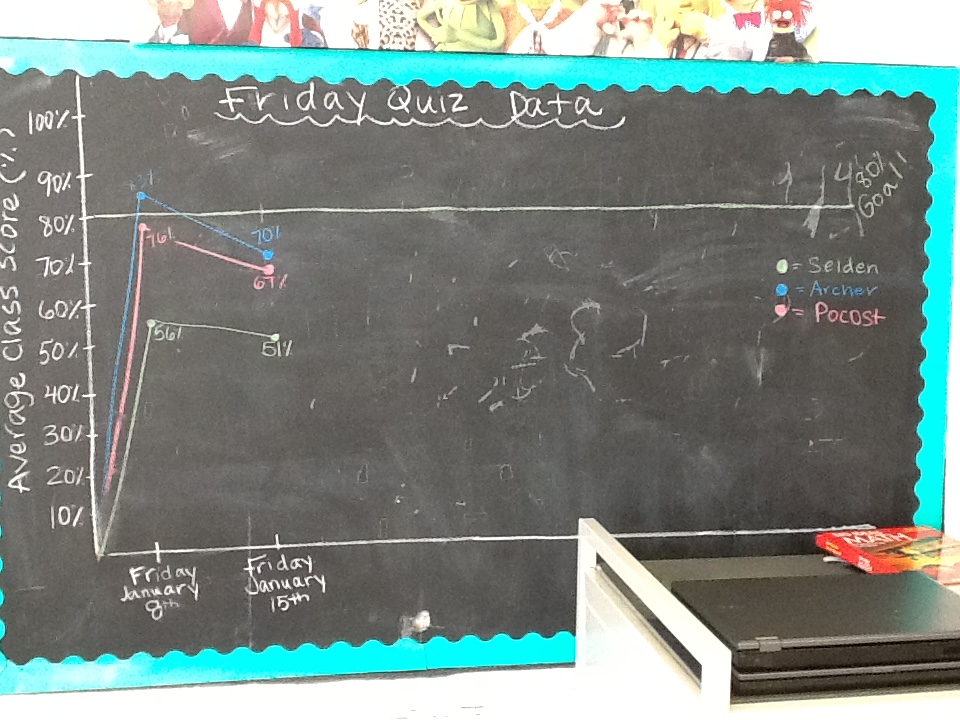
Ms. Archer tracks the performance of her 6th and 7th grade Math students' quiz and homework return rates using two line graph bulletin boards. 

Ms. Cychowski created two anchor charts to help students compare and contrast the similarities and differences between animal and plant cells. 

Ms. Jones' students are working on showing the relationship between fractions and decimals through the work they are doing in Math class. 

Wednesday, December 16, 2015

What's Happening Around Lyon Academy? December 16th, 2015

Take a look at several highlights from around our school this week. If you see an anchor chart, student work, or something else in the building you would like showcased for the staff, please send it to Tyler.Archer@slps.org.

Ms. Connell helps students to prepare for the Acuity Benchmark assessment by reviewing the importance of the test and the expectations so that classmates can be successful. 

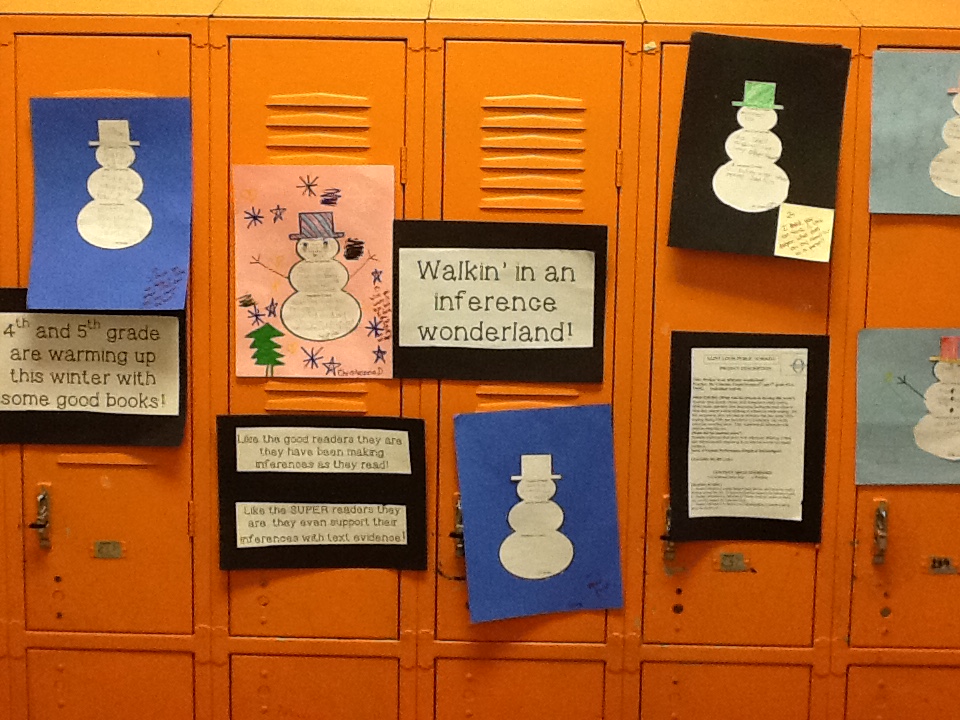
Ms. Colacino's winter bulletin board helps students make inferences by using snowmen as a frame for their thinking. 

Prior to introducing graphing equations, Ms. Walter created a simple anchor chart to keep her students from confusing x and y intercepts. 

Ms. Latta's color coded anchor charts helps students to navigate complicated math problems that involve rounding. 

Mr. Loewenberg and Ms. Archer track the Pre-K students' letter knowledge by publicly showing how many letters each student knows proficiently. 

To help students with 1:1 correspondence and counting, Mr. Loewenberg created an anchor chart to help students visually match their counting with numbers and manipulatives. 

Mr. Loewenberg and Ms. Archer's students created an art project after reading the book "Leaf Man."

Ms. Archer's "Area of a Parallelogram" chart shows both the steps for solving an area problem as well as an example for the students. 

Ms. Selden developed an anchor chart that replicates the procedure for a "quote sandwich" as students work on literary essays. 

Ms. Pocost clarifies the expectations for entering the classroom as well as the Do-Now on this anchor chart that she can easily refer to at the front of her classroom. 

Ms. Welch's students developed a flow chart for how a bill becomes a law in the United States. 


Ms. Cychowski's 7th and 8th grade Science students showed their knowledge of kinetic vs. potential energy, building atoms of energy, and alternative energy in a variety of exploratory classroom projects. 

Ms. Richards helps students to organize and think about the main idea of "Poison Dart Frog" in anticipation of a compare and contrast activity in her classroom by developing a graphic organizer anchor chart.