Thursday, October 29, 2015

What's Happening Around Lyon Academy? October 29, 2015

Take a look at several highlights from around our school this week. If you see an anchor chart, student work, or something else in the building you would like showcased for the staff, please send it to Tyler.Archer@slps.org.


In Ms. Colacino's read alouds of "Wonder," the teacher models how students make inferences about reading and then posts the inferences students make together. 


In Ms. Richards' room, the expectations for using Edmodo are clearly and visually posted. 

Ms. Latta's "I Notice" "I Wonder" anchor charts are student developed and displayed prominently around the classroom. 

Ms. Wolfenden emphasizes the importance of STAR Reading and reminds the students of what they must do to be ready for 3rd grades. 


1st grade readers in Ms. Kempf's class are learning how to read with expression by using punctuation marks. 

Mr. Clark's Word Wall is color coded and prominently displayed in the front of the room. 

In Mr. Loewenberg and Ms. Archer's Pre-K classroom, the expectations for the student activity, "There Was An Old Lady Who Swallowed a Ghost" clearly indicates what students are reading. 

Ms. Cychowski and Ms. Walter  motivate their students during Morning Meeting to earn an incentive. 

Ms. Pocost has her students competing to earn table points for their participation in class. 


Thursday, October 15, 2015

What's Happening Around Lyon Academy? October 15, 2015

Take a look at several highlights from around our school this week. If you see an anchor chart, student work, or something else in the building you would like showcased for the staff, please send it to Tyler.Archer@slps.org.
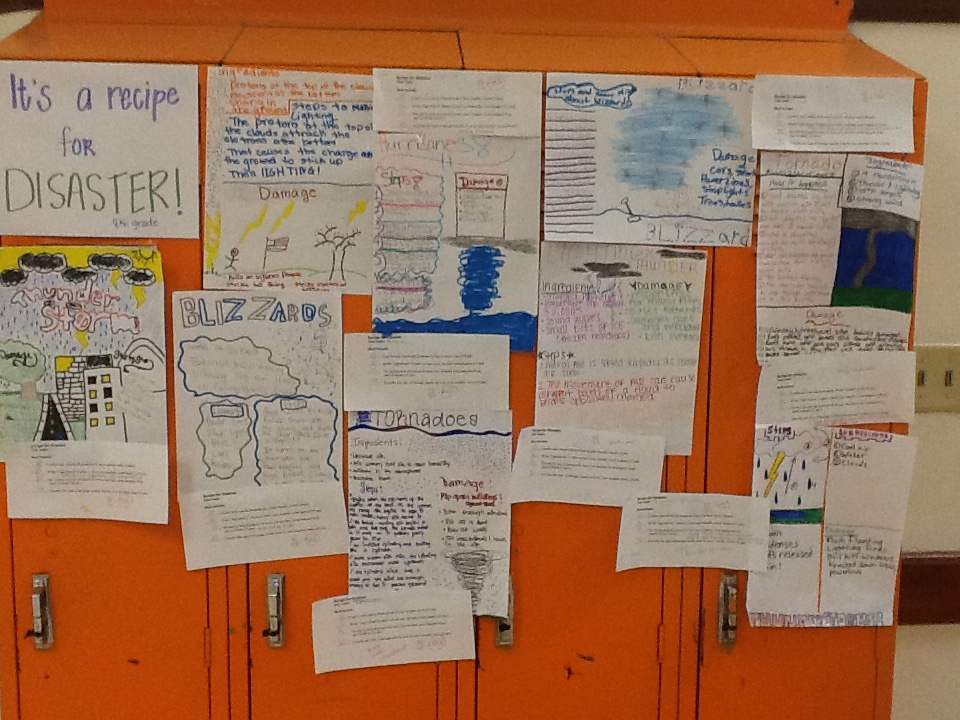
Ms. Cychowski's students analyzed various weather events, their causes, and effects in a study of weather. 

Students in Mr. Goodman's Art classes created colorful images of food. 

Ms. Colacino showcased the "poe-tree" of her students outside her classroom. 

Ms. Latta's 3rd grade students combined Language Arts skills with Science content by writing informative pieces about trees.

Ms. Wolfenden's students practiced making text connections after learning about the skill in read alouds for several weeks. 

Ms. Wolfenden's anchor chart helps students to visualize place value, a difficult elementary Math concept. 

Ms. Selden showcases the students making growth on STAR Reading in her classroom and shows how many months worth of growth they have achieved. 

Ms. Pocost's Electromagnetic Spectrum Anchor Chart helps students with a project as they learn about waves and wavelengths. 

Several teachers have "While You Were Out" boards which are great for helping absent students when they return to your classroom. 

A "3-2-1" is a great Formative Assessment strategy that can be implemented at any stage of a lesson.  
Mr. Clark's students demonstrated knowledge of guitars from their recent lessons by designing their own. 

Ms. Andrews' Text Codes Anchor Chart helps her students to interact with text thoughtfully. Be sure you have a similar anchor chart in your classroom! 

Thursday, October 1, 2015

What's Happening Around Lyon Academy? October 1, 2015

Take a look at several highlights from around our school this week. If you see an anchor chart, student work, or something else in the building you would like showcased for the staff, please send it to Tyler.Archer@slps.org.

Ms. Pocost's students created a machine and followed a rubric to show they included all the relevant components. 


Ms. Jones' middle school students created anchor charts demonstrating how they would teach a skill they are learning in math class. 


Ms. Cychowski taught seventh and eighth grade students about the water cycle by assisting them with creating models of the water cycle. 


Ms. Walter's eighth grade students practiced creating their own tessellations in math class. 


Ms. Kempf's first grade students composed an opinion piece as a part of Writing Workshop.

Ms. Wolfenden's BBC is complete and includes each subject, the Do-Now, objective, and homework. 

Ms. Wolfenden's second grade students are learning about text to self and text to text connections. This anchor chart helps students know the difference. 

Teachers in grades three through five have created a friendly competition to see which class accumulates the most reading minutes! 

Ms. McPherson's fourth grade class completed a touching activity after learning about the Bombing of Birmingham during Morning Meeting. 

Ms. Richards shares her third and fourth grade students' reading talents in conjunction with her "Reading Around the World" theme. 

Wednesday, September 23, 2015

Implementing the SIPPS Intervention Program

SIPPS Overview
SIPPS (Systematic Instruction in Phonological Awareness, Phonics and Sight Words) is a program for developing and struggling readers from kindergarten through grade twelve. SIPPS is a systematic decoding program that helps readers achieve independent, fluent reading through the development of accuracy, automaticity, and prosody so that they can make meaning of increasingly complex texts.

SIPPS supports foundational skill development at Tier 1 for grades K-2 and also as an intervention at Tier 2 or 3 for grades three through twelve.


Assessment
The SIPPS placement assessment determines where each student will be placed within the instructional sequence. The pace of instruction can be adjusted depending on the needs of the group.

SIPPS ongoing progress monitoring is specifically included in the lesson sequence. Periodic mastery tests (every 5-10 lessons) allow teachers to quickly and easily monitor student progress. Teachers should maintain data of how well their students perform on these mastery assessments.

SIPPS Levels
SIPPS is divided into four levels:
1. Beginning- Addresses the simple alphabetic stage of reading: instruction for blending and segmenting to develop phonological awareness; consonants, consonant digraphs, and short vowels for phonics; high-frequency sight words; and fluency practice using controlled-vocabulary text in the form of small books (Grades K-3).

2. Extension- Addresses the spelling-pattern stage: instruction in segmentation and manipulation to develop phonological awareness; blends, finale e, complex vowels, inflectional endings, y at the end of words, and two sounds for c for phonics; high-frequency irregular sight words; beginning instruction in decoding two-syllable words; fluency practice using controlled-vocabulary text provided with the program and then in easy-to-read trade books (Grades K-3).

3. Challenge- Addresses the polysyllabic/morphemic stage of reading development: instructional support for recognizing and reading syllabic patterns and morphological units (prefixes, suffixes, roots) (Grades 2-12).

4. Plus- Addresses students who are in grades 4-12 and are in the simple alphabetic and spelling-patter stages of reading development. Plus provides a more appropriate and accelerated scope and sequence for older students. The book Dreams on Wheels provides corresponding high-interest reading material.

To learn more about individual levels of SIPPS, review PowerPoint presentations, and see sample videos, click here.

For supporting materials and PDFs for each level including lesson materials, assessments, stories and other reproducible materials, click here.


SIPPS Online Access
SIPPS materials are available for access (including manuals, card decks, etc.) via the CCC Learning Hub. All staff members may sign up for an account to access the materials

Access the Learning Hub at this link: https://ccclearninghub.org/user/#/login?returnUrl=https:%2F%2Fccclearninghub.org%2F%23%2F

Did you read this entire blog post? Be the first to e-mail Mr. Archer (Tyler.Archer@slps.org) and receive a donut party for your SIPPS group during the week of September 28th!


Thursday, September 3, 2015

What's Happening Around Lyon Academy? September 3, 2015

Take a look at several highlights from around our school this week. Please take time before Tuesday, September 8th to ensure that all non-negotiables are present in your classroom. If you see an anchor chart, student work, or something else in the building you would like showcased for the staff, please send it to Tyler.Archer@slps.org.

Pre-School students completed an assignment that was connected to a recent read aloud. 

Mr. Craig uses a pennant to display important content words from Physical Education. 

Ms. Welch has a great bulletin board outside of her classroom. All it needs is student work! 

Ms. Selden used the Middle School Engage ELA curriculum as the basis for her student work posting with a rubric, scoring guide, and descriptive feedback. 

Teachers created "Text Code" anchor charts and posted them in their classrooms to support students with text annotations across curriculum. 

Ms. Archer has a clearly displayed entrance procedure for students displayed outside her classroom. 

Ms. Archer's BBC includes the required postings- Do Now, Objective, and Homework. Objectives should be written in "Students will be able to..." format. 

Ms. Selden's class anchor chart shows how students are expected to write with evidence in four easy steps. 

Ms. Selden showcases the current texts being read in her 6th and 7th grade Communication Arts classroom. 
 
Ms. Pocost's Word Wall is interactive and students can add words from their unit of study easily. 
  
Ms. Colacino showcases her students' writing skills outside her classroom with an SLPS project description sheet and scoring guide posted. 

Ms. McPherson's BBC is comprehensive and covers the entire week of lessons for her students. 

In Ms. Richards' class, students assisted in creating an anchor chart as part of their study of Love That Dog.

Ms. Latta posted her students' personal narratives in the hallway along with descriptive feedback for how the writing can be improved during the next assignment. 

Ms. McCord's BBC is simple and easy to read for her students. 

Ms. Salmo created a dry erase Word Wall that can be easily updated, color-coded, and read by her students. 

Ms. Kempf displayed her students' writing work in the hallway along with a clear rubric and task description. 

During Guided Reading, Ms. Kempf is working with her students on how different punctuation marks aid in our reading process. 

Ms. Connell's popcorn holders and popsicle sticks help her assign classroom helpers for a given week.