Thursday, March 26, 2015

What's Happening Around Lyon Academy? March 26th, 2015

Take a look at the sampling of student work, anchor charts and classroom items that have recently been posted around the building. 

If you see an anchor chart, student work, or something else in the building you would like showcased for the staff, please send it to Tyler.Archer@slps.org.

Ms. Colacino's students completed research projects in honor of Black History Month about famous African Americans, completing the entire writing process! 


Mr. Murphy's students presented their knowledge of series and parallel circuits through a poster project. 

Ms. Nertilus' students created sample triangles as a part of a geometry unit. 
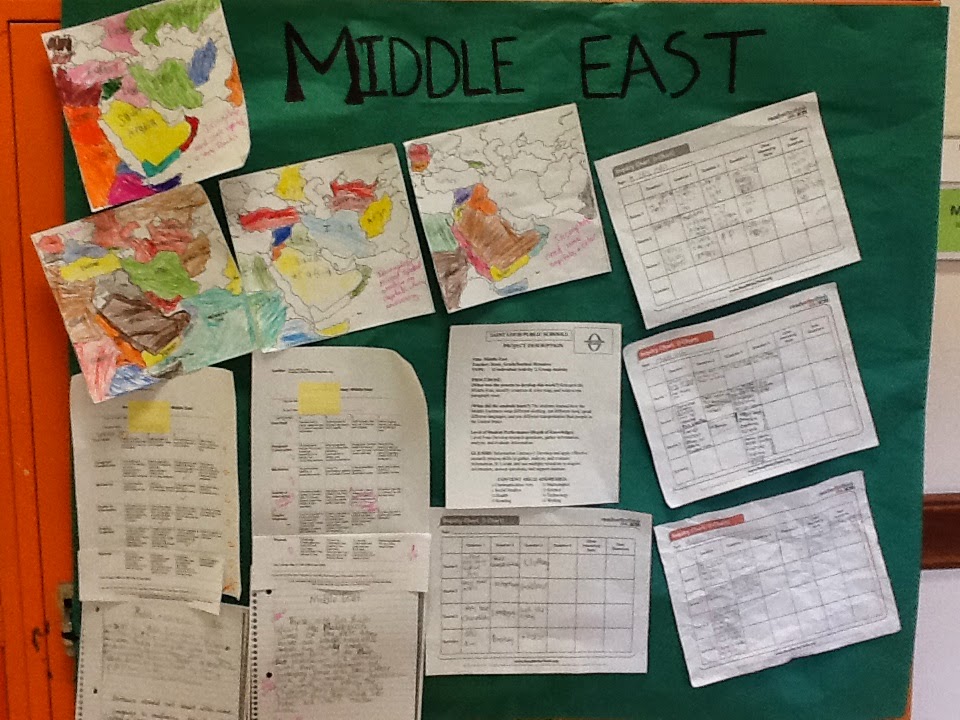
In Ms. Jones' middle school resource classes, students completed a Middle East project that included a map, writing component (with rubric) and Inquiry chart from the Weekly Instructional Strategies! 

Ms. McPherson utilized the Engage NY curriculum to provide feedback to students on rigorous problem sets. 

Students in Ms. Richards' class generated equivalent fractions in small groups and contributed to anchor charts. 

Mr. Phoenix had students complete a formatting task as a review of word processing skills. 

Mr. Schwerdt's anchor charts make the expectations for behavior clear in the gym during PE. 

Students even write during PE class! 

Spanish students in Ms. Mosby's class created a foldable to represent new knowledge. 

During MAP review days, Mr. Murphy has students solve complex problems then reflect on their learning using a rubric to evaluate peer work. 

Ms. Weininger's students used graph paper to represent the geometric concepts they are learning in 6th and 7th grade Math. 

Ms. Latta provided specific feedback to students on a writing task and gave praise for improvements from the last assignment students completed. 

Second grade students in Ms. Tuthill's class described different parts of their day while learning to tell time. 


Three great anchor charts are being used in second grade classrooms to help students with difficult concepts-- "Ways to Move a Shape!" and "Measuring Time" in Ms. Tuthill's class and "Measurement" in Ms. Latta's class. 

In Ms. Salmo's class students reflected on the St. Patrick's Day holiday by writing about a prompt, "Who is worth more to you than gold?"


Ms. Cleland's students wrote a reflective narrative about their Spring Break. 

Ms. Colacino helps her students to think about proper responses to misbehavior. A great topic for morning meetings! 

Did you read all the way to the bottom? Be one of the first four people to read this far and send Mr. Archer an e-mail to receive a coffee next week! 

Friday, March 6, 2015

Classroom Non-Negotiable Focus: Lesson Includes Guided Practice

This week's Lyon Academy Instructional Blog post focuses on the classroom non-negotiable of Guided Practice.

Guided Practice provides an opportunity for the teacher to provide feedback to students without grading. Guided Practice is a central part of the lesson that is both student-led and differentiated. This is the "We Do" portion of a lesson where the teacher provides supports but allows students to work with some autonomy.

Today, I observed an excellent example of Guided Practice in Ms. Tuthill's classroom. After modeling a non-fiction reading task of identifying the main idea with a text on the Smart Board, Ms. Tuthill divided her students into instructional groups who followed the same procedure using a different article.


Each group of students read a different article, then created a poster presentation. One strategy to incorporate during Guided Practice is teacher and peer feedback. During student presentations, Ms. Tuthill and her students had a chance to ask questions and critique the student work. What an awesome higher level task!

Total Participation Techniques (TPTs) and Kagan Strategies are great for incorporating at the Guided Practice stage of a lesson. Resources for these strategies can be found on the Professional Development website.

In Teach Like a Champion, Doug Lemov outlines two powerful Guided Practice strategies that can be used throughout the lesson:


  • Technique 16: Break it Down: One of the best ways to present material again is to respond to a lack of clear student understanding by breaking a problematic idea down into component parts.


  • Technique 17: Ratio: A successful lesson is rarely marked by a teacher's getting a good intellectual workout at the front of the room. Push more and more of the cognitive work out to students as soon as they are ready. 


Here are some other Peer-to-peer support strategies that can be implemented to support Guided Practice throughout the lesson and make the "We Do" portion of the learning more effective for students:


  • Observe student work carefully during independent work- enlist strong students to help weaker students determine right answer during review of assignments.
  • Have students teach parts of the lesson to small groups of their peers.
  • Have students run stations.
  • Train peer tutors- teach student tutors how to ask questions in stead of giving answers and how to get the tutee to do most of the talking.
  • Think, pair, share: Have students think of the answer, talk with a partner, and then share as a large group. 
  • Turn and talk: students turn toward partner and explain answers to a question.
  • Peer to group: student models think aloud.
  • Implement peer editing and revision.
  • Develop study groups that jigsaw activities and content.
  • Create mentoring relationships across grade levels. 


Thursday, February 26, 2015

Classroom Non-Negotiable Focus: Lesson Includes Checking for Understanding

This week's Lyon Academy Instructional Blog post focuses on the classroom non-negotiable of Lesson Includes Checking for Understanding.

Throughout a lesson, it is necessary to establish whether or not all students are exhibiting and displaying understanding. There are numerous assessment types and strategies that teachers can use to evaluate a student's progress towards a learning target or learning objective. An effective Check for Understanding involves gathering data constantly and acting on this data immediately.

In Teach Like a Champion, Doug Lemov outlines a number of principles for an effective Check for Understanding in a lesson. The following two websites give an overview of the technique:

http://teachlikeachampion.com/tag/check-for-understanding/ 

http://specialed.about.com/b/2010/09/06/teach-like-a-champion-technique-18.htm

Earlier this year, I shared the following Check for Understanding resources with the staff: 

https://sites.google.com/site/lyonblowpd/weekly-instructional-strategies/weekofaugust18th-22nd

Socrative is another resource that may be useful for teachers to incorporate technology with the process of Checking for Understanding. http://www.socrative.com/

This week, I observed Checking for Understanding in a number of classrooms. Here are a few visual examples that can be used in the classroom:


In these two images, Ms. Colacino monitors students' progress in Writing Workshop by having students self-assess their progress and move their clothespins up and down the chart to represent their stage of work. This is an effective way to identify students who need additional support. 

Ms. McCord uses a KWL Chart to assess what students learned over the course of a lesson about fossils. 


Here are some techniques that can be implemented to support Checks for Understanding throughout various stages of a lesson and make them more effective:

Questioning
  • Develop whole class responses to student answers (for example, snap if you agree, stomp if you don't) to engage 100 percent participation.
  • Use cold call: Avoid just calling on students with hands raised. 
  • Move from ping-pong to volleyball: Instead of responding to every student answer yourself, get other students to respond to each other: "Do you agree with Sam?" "Why is that answer correct (or incorrect)?" "What would you add?"
  • Script questions in advance of the lesson to make sure they scaffold appropriately and address rigor at varied levels. 
  • Have an observer record teacher questions: highlight where students are succeeding and where they can grow.
Addressing Student Error
  • Have a student who struggled initially repeat the correct answer eventually produced by the whole class.
  • Use whiteboards to have every student write down a response to question: whole class shows answers simultaneously so teacher can immediately check to see how many students answered correctly. 
  • Write questions in plan to specific students who are struggling with a standard and jot down their responses in the plans during class.
  • Note in your book or lesson plan what questions students answer incorrectly; call on them again when you revisit that sort of question later in the week.
  • Choose "No Opt Out": do not let students off the hook when struggling with an answer. 


Wednesday, February 25, 2015

What's Happening Around Lyon Academy? February 25th, 2015

Take a look at the sampling of student work that has recently been posted around the building. If you have not updated your student work at this time, please do so prior to the end of the week.

If you see an anchor chart, student work, or something else in the building you would like showcased for the staff, please send it to Tyler.Archer@slps.org.

Ms. Allen's students learned about different historic figures and completed reading graphic organizers for Black History Month. 

Ms. Latta's students created a three-fold foldable to compare and contrast two things they were familiar with after practicing the skill in the classroom. 

In honor of Presidents' Day, Ms. Tuthill's students wrote reflections about "If I were President..."

In Kindergarten and First Grade, Ms. Salmo's students created a picture and explained what their neighborhood looks like. 

Ms. Colacino continued her review of inferences with students by having them make inferences from poetry and completing a graphic organizers. 

Ms. Richards' students created a representation of fractional numbers during their unit about fractions. 

First grade students in Ms. Cleland's class celebrated winter with a snow globe writing assignment. 

Friday, February 20, 2015

Classroom Non-Negotiable Focus: Instruction Involves Input and Modeling

This week's Lyon Academy Instructional Blog post focuses on the classroom non-negotiable of Instruction Involves Input and Modeling.

Over the course of a lesson, students should experience a "gradual release of responsibility." This occurs through the I Do-We Do-You Do process. The model below shows how a lesson looks when following this model:


The pictures below from Ms. Richards' classroom demonstrate how "I Do, We Do, You Do" was implemented in a fractions lesson.


I Do
In a previous lesson, students reviewed fractional parts and created a flipbook that represents the numeric fraction (i.e. 1/2), the term ("fourth," "fifth") and a strip that showed what the fractional part looked like.

Next, as the I Do portion of the lesson, Ms. Richards modeled how to plot fractions on a number line using chart paper in the mini-lesson.


We Do
For the guided practice portion of the lesson, students had problems that were the exact same. Students worked on the problems and the teacher circulated to provide feedback to the partners during their work.


You Do
Finally, for independent work, students practice problems on their own. This is a sample of a work product from another lesson that students created independently.


When thinking about I Do-We Do-You Do, a critical component is the Ratio of work that students are completing. Teacher should be reduced over the course of the lesson and student thinking must be pushed. Here are some techniques that can be implemented to support Ratio:


  • Require students to support answers with evidence from the text.
  • Feign ignorance (for example, write wrong answer that student gives on the board, let students find the error rather than correcting it yourself; pretend you don't even know the answer is wrong). 
  • Ask students: "put it in your own words" about a classroom definition, concept, and so on.
  • Reword question to force students to think on their feet about the same skill.
  • Use Wait Time to give more students the chance to think through the answer.
  • Model "Right is right": press to 100 percent correct answer.
  • Check for student use of specific strategies and not just correct answers. 
  • Ask "what if" question: "What if" I took away this information from the problem, how would you approach it? 
For additional Ratio strategies to support the implementation of I Do-We Do-You Do, see the links below:

Thursday, February 12, 2015

Classroom Non-Negotiable Focus: High Quality Learning Objectives

This week's Lyon Academy Instructional Blog post focuses on the classroom non-negotiable of High Quality Objectives. 

Objectives are the specific, measurable learning targets for a particular lesson. Objectives should be written in student-friendly language, be aligned to a standard, and include both what a student will know and do as a result of the lesson. Objectives should be written in one of the following or similar formats:

  • SWBAT (Students will be able to...)
  • IWBAT (I will be able to...)
  • I can....
  • I will...
The Objective most be posted and updated as part of the classroom BBC daily. Additionally, teachers should state the objective and re-state it throughout the lesson. Here are some exemplars from our building that reflect the components of effective objectives:

Ms. Tuthill writes her students' objectives as "I can.." objectives. Even though she has many objectives during her lessons, she writes all of them and includes specific actions/outputs of the students. 

Ms. Colacino's BBC includes objectives for Reading, Writing and Spelling that use strong verbs-- "compare and contrast," "create," and "determine."

Ms. Weininger's Math objectives are specific, student-friendly and simple. 

Mr. Murphy's more complex objective addresses a larger project that students are creating in his classroom.

To improve your Learning Objectives, incorporate some of the following strategies:
  • Connect objective to how the students will be assessed.
  • Write "know/do" objectives: Students will know _____ by doing _____.
  • Look at test questions beforehand to be sure the skills assessed on the test were worked into the daily lesson.
  • Write an assessment of the skills immediately after the objective, at the top of the lesson plan.
  • First write assessment questions that align to objective; then break the objective into smaller chunks that will ensure mastery of all the skills needed to answer each question correctly.
  • Use verbs from Bloom's taxonomy to ensure that the objective is rigorous. 

See additional examples and resources for Learning Objectives that you may think about using in your classroom:


"4Ms" Strategy for Learning Objectives from Teach Like a Champion- http://tlacashleyb.weebly.com/the-4ms.html 


Friday, February 6, 2015

Classroom Non-Negotiable Focus: Do-Now Tasks

Beginning this week, the Lyon Academy Instructional Blog will focus a different classroom non-negotiable each week. This week, I will give some further explanation of how to strengthen our Do-Now tasks.

Do-Now tasks can take a variety of forms, but must adhere to the following guidelines:
1. Be a task that students can begin independently upon entering the classroom or transitioning to a new subject.
2. Not exceed 3-5 minutes in duration.
3. Be an independent, pencil to paper activity.
4. Review a skill from previous lessons or anticipate new content in the lesson for the day.

Do-Now tasks must be posted on the BBC daily. In the first image below, Ms. Mosby writes the specific Do-Now for each day's lesson. The activity is a short activity to engage the students in Spanish content and prepare them for the day's lesson.


Do-Now tasks may also be posted on the Smart Board. Be sure to write "On Smart Board" or "On projector" on your permanently posted BBC. Ms. Weininger's Do-Now does this. If you take a look at her Do-Now below, it reviews a variety of skills in various formats to prepare the students for the day's lesson and also review content that has been taught previously. 


To improve your Do-Now, incorporate some of the following strategies:
  • Use the Do-Now as a re-teach tool: Write questions that students struggled to master on the last quarterly assessment.
  • Use mixed-format questions for a skill: multiple-choice, short answer, open-ended, and so on.
  • Organize questions sequentially according to difficulty.
  • Spiral objectives, skills, and questions from everything previously learned to keep student learning sharp.
  • Develop Do-Now tracking sheet for teachers and students that shows student performance on the skills in each Do-Now.
  • Make Do-Nows that look like test questions and make sure they are reviewed in class.
  • Observe students' answers during Do-Now and note kids with wrong answers to follow-up with them during oral review.
  • Add multiple-choice questions to Do-Now to allow real-time assessment.
  • Add why and how questions (for example, Why did you choose this answer? How do you know your answer is correct?) for different levels of learners and to push thinking. 
  • Revisit yesterday's objectives in the Do-Now.
  • Collect and grade four straight Do-Nows, and for the fifth day let students correct their first four Do-Nows for extra points towards their Do-Now grades. 

See additional videos/examples for Do-Now activities that you may think about using in your classroom: