Friday, February 20, 2015

Classroom Non-Negotiable Focus: Instruction Involves Input and Modeling

This week's Lyon Academy Instructional Blog post focuses on the classroom non-negotiable of Instruction Involves Input and Modeling.

Over the course of a lesson, students should experience a "gradual release of responsibility." This occurs through the I Do-We Do-You Do process. The model below shows how a lesson looks when following this model:


The pictures below from Ms. Richards' classroom demonstrate how "I Do, We Do, You Do" was implemented in a fractions lesson.


I Do
In a previous lesson, students reviewed fractional parts and created a flipbook that represents the numeric fraction (i.e. 1/2), the term ("fourth," "fifth") and a strip that showed what the fractional part looked like.

Next, as the I Do portion of the lesson, Ms. Richards modeled how to plot fractions on a number line using chart paper in the mini-lesson.


We Do
For the guided practice portion of the lesson, students had problems that were the exact same. Students worked on the problems and the teacher circulated to provide feedback to the partners during their work.


You Do
Finally, for independent work, students practice problems on their own. This is a sample of a work product from another lesson that students created independently.


When thinking about I Do-We Do-You Do, a critical component is the Ratio of work that students are completing. Teacher should be reduced over the course of the lesson and student thinking must be pushed. Here are some techniques that can be implemented to support Ratio:


  • Require students to support answers with evidence from the text.
  • Feign ignorance (for example, write wrong answer that student gives on the board, let students find the error rather than correcting it yourself; pretend you don't even know the answer is wrong). 
  • Ask students: "put it in your own words" about a classroom definition, concept, and so on.
  • Reword question to force students to think on their feet about the same skill.
  • Use Wait Time to give more students the chance to think through the answer.
  • Model "Right is right": press to 100 percent correct answer.
  • Check for student use of specific strategies and not just correct answers. 
  • Ask "what if" question: "What if" I took away this information from the problem, how would you approach it? 
For additional Ratio strategies to support the implementation of I Do-We Do-You Do, see the links below:

Thursday, February 12, 2015

Classroom Non-Negotiable Focus: High Quality Learning Objectives

This week's Lyon Academy Instructional Blog post focuses on the classroom non-negotiable of High Quality Objectives. 

Objectives are the specific, measurable learning targets for a particular lesson. Objectives should be written in student-friendly language, be aligned to a standard, and include both what a student will know and do as a result of the lesson. Objectives should be written in one of the following or similar formats:

  • SWBAT (Students will be able to...)
  • IWBAT (I will be able to...)
  • I can....
  • I will...
The Objective most be posted and updated as part of the classroom BBC daily. Additionally, teachers should state the objective and re-state it throughout the lesson. Here are some exemplars from our building that reflect the components of effective objectives:

Ms. Tuthill writes her students' objectives as "I can.." objectives. Even though she has many objectives during her lessons, she writes all of them and includes specific actions/outputs of the students. 

Ms. Colacino's BBC includes objectives for Reading, Writing and Spelling that use strong verbs-- "compare and contrast," "create," and "determine."

Ms. Weininger's Math objectives are specific, student-friendly and simple. 

Mr. Murphy's more complex objective addresses a larger project that students are creating in his classroom.

To improve your Learning Objectives, incorporate some of the following strategies:
  • Connect objective to how the students will be assessed.
  • Write "know/do" objectives: Students will know _____ by doing _____.
  • Look at test questions beforehand to be sure the skills assessed on the test were worked into the daily lesson.
  • Write an assessment of the skills immediately after the objective, at the top of the lesson plan.
  • First write assessment questions that align to objective; then break the objective into smaller chunks that will ensure mastery of all the skills needed to answer each question correctly.
  • Use verbs from Bloom's taxonomy to ensure that the objective is rigorous. 

See additional examples and resources for Learning Objectives that you may think about using in your classroom:


"4Ms" Strategy for Learning Objectives from Teach Like a Champion- http://tlacashleyb.weebly.com/the-4ms.html 


Friday, February 6, 2015

Classroom Non-Negotiable Focus: Do-Now Tasks

Beginning this week, the Lyon Academy Instructional Blog will focus a different classroom non-negotiable each week. This week, I will give some further explanation of how to strengthen our Do-Now tasks.

Do-Now tasks can take a variety of forms, but must adhere to the following guidelines:
1. Be a task that students can begin independently upon entering the classroom or transitioning to a new subject.
2. Not exceed 3-5 minutes in duration.
3. Be an independent, pencil to paper activity.
4. Review a skill from previous lessons or anticipate new content in the lesson for the day.

Do-Now tasks must be posted on the BBC daily. In the first image below, Ms. Mosby writes the specific Do-Now for each day's lesson. The activity is a short activity to engage the students in Spanish content and prepare them for the day's lesson.


Do-Now tasks may also be posted on the Smart Board. Be sure to write "On Smart Board" or "On projector" on your permanently posted BBC. Ms. Weininger's Do-Now does this. If you take a look at her Do-Now below, it reviews a variety of skills in various formats to prepare the students for the day's lesson and also review content that has been taught previously. 


To improve your Do-Now, incorporate some of the following strategies:
  • Use the Do-Now as a re-teach tool: Write questions that students struggled to master on the last quarterly assessment.
  • Use mixed-format questions for a skill: multiple-choice, short answer, open-ended, and so on.
  • Organize questions sequentially according to difficulty.
  • Spiral objectives, skills, and questions from everything previously learned to keep student learning sharp.
  • Develop Do-Now tracking sheet for teachers and students that shows student performance on the skills in each Do-Now.
  • Make Do-Nows that look like test questions and make sure they are reviewed in class.
  • Observe students' answers during Do-Now and note kids with wrong answers to follow-up with them during oral review.
  • Add multiple-choice questions to Do-Now to allow real-time assessment.
  • Add why and how questions (for example, Why did you choose this answer? How do you know your answer is correct?) for different levels of learners and to push thinking. 
  • Revisit yesterday's objectives in the Do-Now.
  • Collect and grade four straight Do-Nows, and for the fifth day let students correct their first four Do-Nows for extra points towards their Do-Now grades. 

See additional videos/examples for Do-Now activities that you may think about using in your classroom:


Friday, January 30, 2015

Updated Student Work- BIG FRIDAY Bonus Edition!

Alright, alright, alright...take a look at today's BIG FRIDAY student work BONUS EDITION! The updates made to the student work in the hallway are much appreciated.
Thank you for a great January! Keep up the excellent work and support you give our students!

Ms. Salmo's students used handprints to learn about transformations of geometry shapes. 

Ms. Jones' resource students read a story about an inventor, then created a comic strip to visually represent the process that an inventor uses when coming up with new ideas. 

Mr. Phoenix's students created a brochure about the solar system and followed a comprehensive analytic rubric to assess their finished product. 

In Spanish, Ms. Mosby's students created creatures as a way of learning about human body vocabulary terms. 

Mr. Swanston's students completed a booklet about the Bill of Rights in preparation for taking the 8th grade Constitution test. 

Ms. Colacino's students used "Genius Time" to develop and research wonderings they had about various nonfiction topics, then wrote about them in Writer's Workshop. 

Tuesday, January 20, 2015

What's Happening Around Lyon Academy? January 20th, 2015

It has been more than a month, but I was finally able to visit every classroom this morning to conduct a non-negotiable learning walk. Take a look at some of the great things happening around our building. Please take time  to ensure that all non-negotiables are present in your classroom. Don't forget to look at previous blog posts to find ideas and examples of non-negotiables in classrooms or inspiration! 

In terms of student work, there is an overall major improvement in the quality of rubrics and feedback posted across the building. Keep up the good work! 

If you see an anchor chart, student work, or something else in the building you would like showcased for the staff, please send it to Tyler.Archer@slps.org.

This anchor chart in Ms. Richards' room helps students to easily identify the operation required for math tasks by giving examples of various terminology used. 

Ms. Salmo's students used their names to practice addition and subtraction. 


Ms. Tuthill's and Ms. Latta's students reflected on their own dreams and wrote about them as a part of celebrating Dr. Martin Luther King, Jr. 

Ms. McCord's students recorded data from a scientific trial during an experiment. 

Ms. Richards' students received descriptive feedback aligned to a supporting rubric. 

Ms. Richards caught her students in action reading! 

In Ms. Colacino's classroom, students can reference these anchor charts during their reading to support their comprehension. 

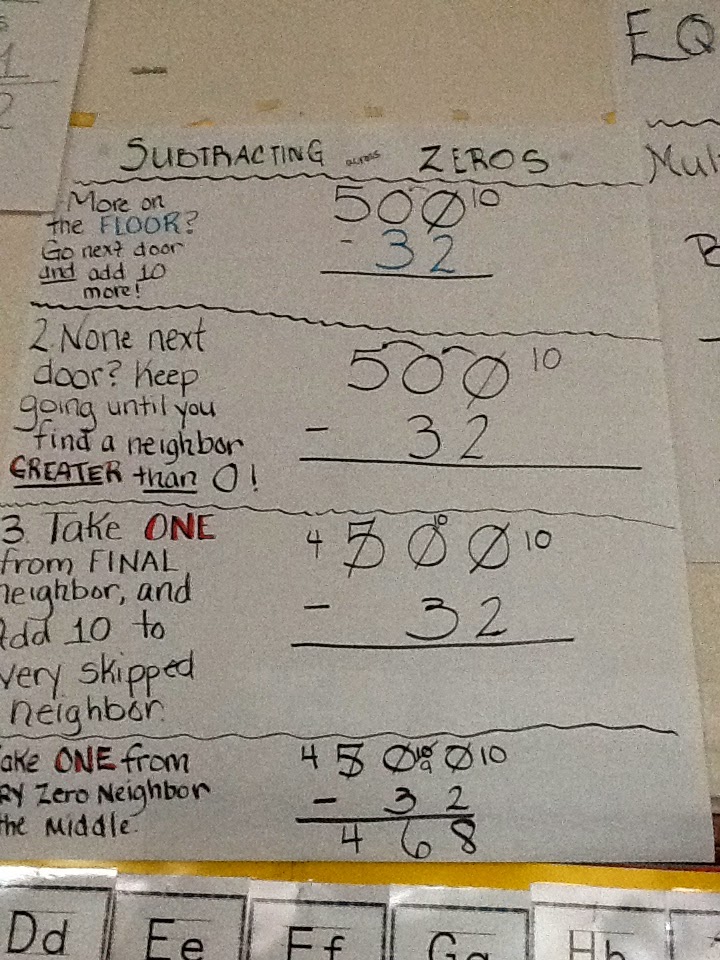
To help students who were struggling with a complex subtraction task, Ms. McPherson created anchor chart that displayed both the directions and steps. 

Ms. Williams' students received individual rubrics and feedback on their work. 

Mr. Phoenix supports his Writing Workshop students with a "Parts of Speech" anchor chart that includes specific examples. 

Ms. Allen's students wrote resolutions for the new year and had them posted in the hallway with a scoring guide. 

Mr. Murphy's students completed claim evidence journal writing assignments to prepare for constructed response portions of the MAP test and to reflect on results of their experiments. 


Ms. Jones created two anchor charts to help her students with basic skills they may need support with during class. 

Ms. Weininger helped her students break down complex area problems by creating step-by-step anchor charts. 


Ms. Weininger's students demonstrated their understanding of area formulas by creating and solving their own problems. 

Ms. Selden's anchor chart helps students to think broadly about text structures and purposes for informational texts as they read. 

Thursday, December 11, 2014

What's Happening Around Lyon Academy? December 11th, 2014

Take a look at several highlights from around our school this week as we prepare for next Wednesday's District Learning Walk. Please take time before the end of the week to ensure that all non-negotiables are present in your classroom.Don't forget to look at previous blog posts to find ideas and examples of non-negotiables in classrooms.
 If you see an anchor chart, student work, or something else in the building you would like showcased for the staff, please send it to Tyler.Archer@slps.org.


Ms. Nertilus has a large, easy to read BBC posted at the front of her classroom. 


Ms. Mosby uses students' interest in Instagram to promote positive relationships with her students. 


Ms. Mosby posts her lesson plans at the door, along with other important information for students. 


Ms. Jones' Word Wall is easy to read, clearly labeled, and sorted by letter of the alphabet. 


Ms. Weininger's anchor chart helps students to determine the next step in a mathematical problem or equation by identifying the required function. 


Ms. McPherson's detailed BBC includes her objective, agenda, do-now and differentiated homework for each grade level (3rd-5th). 


Ms. Cleland's snowman connects student work with the change of the seasons. 


This anchor chart from Ms. Cleland's room can be used throughout the year as students explore themes of different stories they read. 


Ms. Salmo's students completed a visualization activity that also includes a scoring guide. 


Ms. Allen's students recently read the book Bronx Masquerade and wrote poetry inspired by their reading! 

Thursday, October 30, 2014

What's Happening Around Lyon Academy? October 30th, 2014

Take a look at several highlights from around our school this week as we prepare for next Wednesday's District Learning Walk. Please take time before the end of the week to ensure that all non-negotiables are present in your classroom.Don't forget to look at previous blog posts to find ideas and examples of non-negotiables in classrooms.
 If you see an anchor chart, student work, or something else in the building you would like showcased for the staff, please send it to Tyler.Archer@slps.org.

Ms. Latta has clearly posted expectations for what students should be doing during IDR time. 

Ms. McCord created an easy visual and written reminder for students about how matter changes states. 

Ms. Richards used a double entry journal format with her students to help them explain their visualizations from the text they read together in class. 

Ms. McPherson's student work bulletin board was a unique twist on the "Arrays" students are learning about in her classroom. 

Ms. Weininger's colorful anchor chart helps remind students how to plot points on a coordinate plane. 


Ms. Jones uses an acronym to review order of operations with students. 

Ms. Allen's BBC board is user friendly and easy for students to read. It goes beyond the requirements and gives students even more information about the day's learning.